



 Bestselling Author Freida McFadden Reveals Her True Identity



7 min read
6 min read
13 min read
8 min read


7 min read


In 1944, a teenage boy arrived at Auschwitz and watched his mother and siblings sent to the gas chambers. This is how Leibish Gottesman survived, and what he built from the ashes.
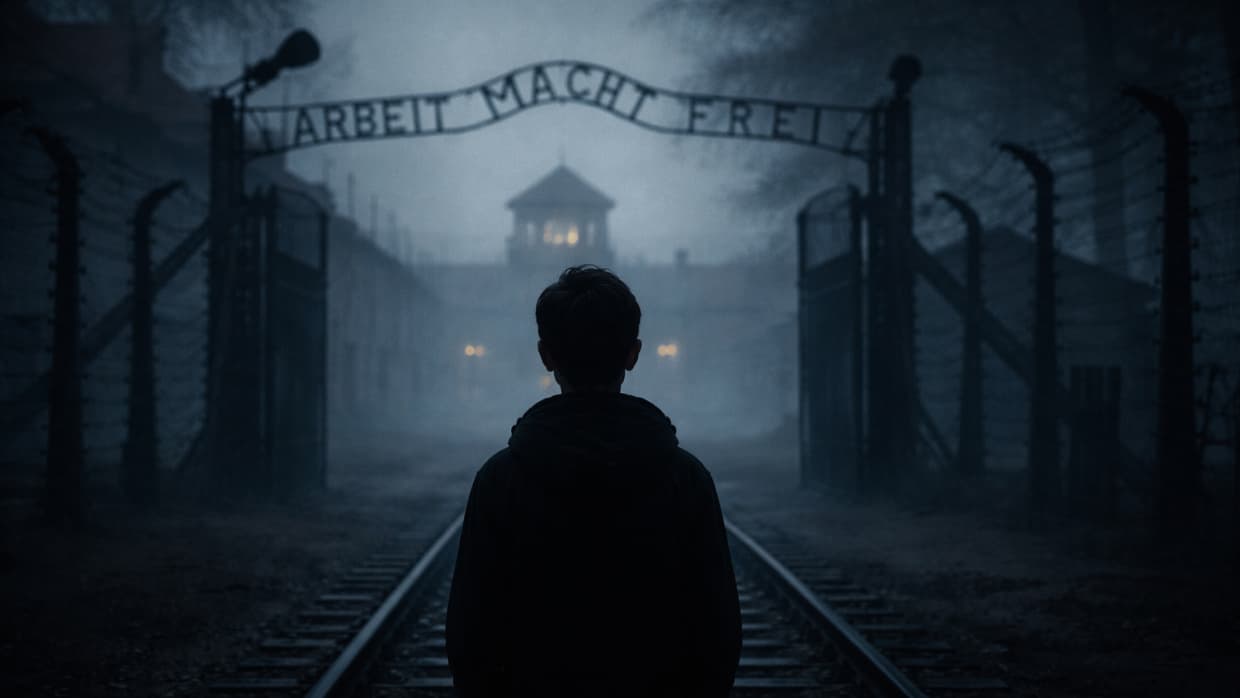
It was 1944. A teenage boy, Aryeh Leibish Gottesman, had been rounded up by the Nazis with his mother and seven siblings. They were forced into cattle cars full of thousands of Jewish prisoners. Their destination? Auschwitz-Birkenau in Poland.
Aryeh, who went by his middle name, Leibish, and the other prisoners suffered on the train. There was only one small toilet and one tiny window, offering a little bit of fresh air. There was no place to sit. The older people stood the entire time. The children sat on the floor under the legs of the older people and cried their hearts out. Everyone was given a little bit of water, but no food.
The train stopped several times for short intervals. One of these times was in Budapest. People who were on the same wagon as Leibish encouraged him to escape. “Do not be fools!” they yelled. “You can see where we are heading. Save your lives and jump out of the train!”
Leibish’s mother had gotten sick on the train, and he didn’t want to abandon her. “I can’t jump because I cannot leave my mother alone!”
After three horrendous days, they finally arrived at their destination in Auschwitz on June 11th, 1944, the 20th of Sivan, a day when many calamities occurred throughout Jewish history. It was a Sunday, and for some unknown reason, the people were forbidden to leave the train for the entire day. When night came, the passengers were callously emptied from the train and forced to leave behind all their possessions.
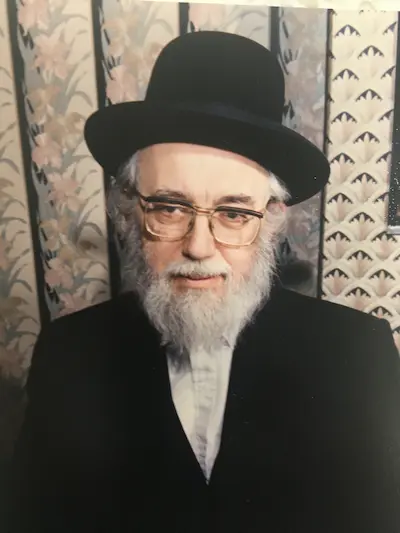
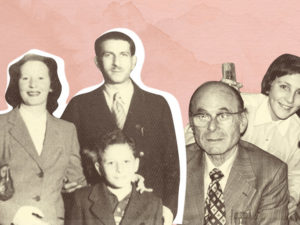
 The author, right, with his father
Right away, Leibish and the others saw smoke coming out of the crematorium. In their worst nightmares, they never could have imagined what this smoke was, and that many of their relatives had already been incinerated in these ovens. Leibish thought the smoke was coming from a bakery.
Leibish and his fellow passengers filed past the infamous “angel of death,” Dr. Josef Mengele, who, with the flick of his finger, could condemn you to death. To the right meant life, to the left meant the gas chambers. He decided the fate of millions of people. You would only be given the chance to live if you were 18 or older and you could work.
Leibish, who was tall and wore two coats, looked like a well-built adult. He was sent to the right. His mother and six of his siblings – save for one brother – were sent to the left.
That was the last time Leibish saw them. A few days later, he learned the terrible truth: they had been sent to the gas chambers.
His entire world was shattered. But somehow, he has been spared.
Everyone who survived the lines was shaven from head to toe. They were scrubbed from head to toe with a metal brush which was excruciating.
Once this brutal process was over, the prisoners was ordered into the washrooms. The Nazis maneuvered either extremely hot or extremely cold water to come out of the showerheads in order to torment the prisoners and strip them of their dignity.
Leibish was taken to an empty barrack, waiting for the next transport to Germany. For the next month he slept on the freezing floor with the other prisoners and only received a quarter of a slice of bread daily.
On July 11, he was taken to a concentration camp called Allach in Germany, from where he was transferred for assigned slave laborer in Muhldorf, a subdivision of Dachau. After two weeks of backbreaking labor, he fainted and was taken to a clinic. The doctor diagnosed him with life-threatening pneumonia.
 They decided to send him to the big clinic “gas chamber” in the main concentration camp in Dachau. He was put on a truck, together with two other people. One was dead, and the other was a person who had also been diagnosed with pneumonia.
The truck driver mistakenly took them to the clinic designated for POWs. This error saved Leibish’s life.
At the clinic, a doctor from Holland examined him thoroughly and immediately noticed that there was a mistake: this person, with weak and skeletal body, was no POW. The doctor asked him: “What are you doing here?”
Leibish told him the truth: “Ich bin Jude -- I am a Jew. The doctor took Leibish’s documents and told him, “Do not worry. I will take care of you and heal you.”
Like all the other Jews in Nazi-occupied territory, there was the letter “J” written on Leibish’s identification card, which meant he was Jewish. The doctor took a pen and quickly changed the letter from a “J” to an “S,” which stood for Slovakia. This was true because Leibish was a Slovakian native. This way, the doctor could now “legally” keep him under his custody and care.
While Leibish recovered, he eventually became ill several more times in Dachau, and he survived it because of another guardian angel: Mr. Springer, a tailor and shoemaker in the camp who hired Leibish to work on shoes. Leibish earned his share in bread which sustained him until his liberation.
Finally, in March 1945, the thunderous noise of large bombs was heard in Dachau. In the ears of the prisoners, these frightening booms were the best sound, heralding their imminent freedom. The allied forces were inching ever closer.
The panicked Nazis arranged a transport for Leibish and the other prisoners to an open, deserted field in Seiwald, underneath the Alps of Austria, for their final elimination. Within hours, however, the Nazis retreated and escaped, afraid of falling to the Allied forces.
In July 1945, Leibish was finally liberated. At this point, he was 6’2 and weighed 99 pounds. He had survived, but barely.
He traveled to his hometown only to learn the devastating news: It had been destroyed. Life as he knew it was gone forever. Only his brother Kalman had made it through.
Leibish knew he had to leave Europe, so he emigrated to America to study in yeshiva and devote his life to Torah learning. He learned 18 hours per day in yeshiva and became the star pupil. In 1956, he married Rikel, also a Holocaust survivor who lost both of her parents at six years old. Together, they had seven children: four boys and three girls.
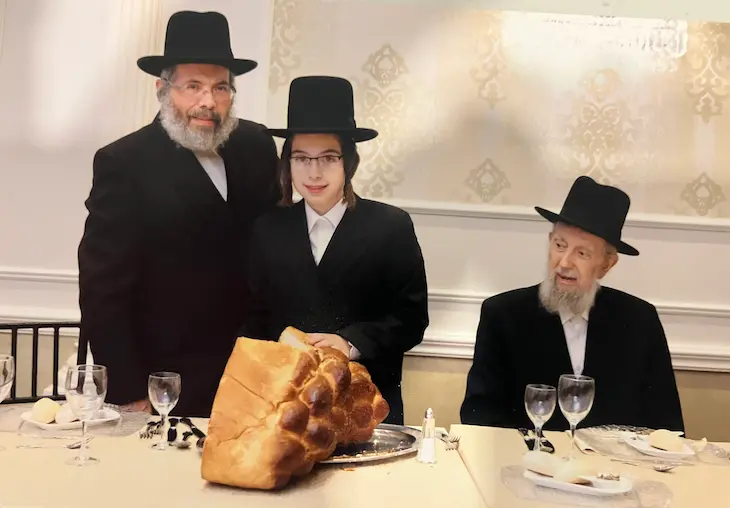
In 2016, at the age of 88, Leibish passed away, leaving behind his wife, children, and grandchildren. His legacy continues with five living generations, and over 600 descendants, who are proud, observant Jews. They carry on his family name and memory.
With the rise of antisemitism throughout the world, the story of Leibish and many other survivors give us hope and inspiration, showing that miracles do occur.
This Yom HaShoah (Holocaust Remembrance Day), we must do more than mourn. We must tell these stories — in our homes, in our classrooms, to Jews and non-Jews alike. Survivors are leaving us. Soon, firsthand accounts will be gone. The stories that remain are not just history. They are a lifeline.
Leibish's story is proof that miracles happen. And that the most powerful act of defiance against genocide is simply — to live, and to keep going.









Inspirational article. Thank you for publishing.
Am Yisrael Chai!
Israel says it killed Hezbollah chief’s personal secretary in Beirut strike on Wednesday