



 Bestselling Author Freida McFadden Reveals Her True Identity



11 min read
12 min read
4 min read


7 min read


We remember the Holocaust to honor the victims, confront human evil, and learn how faith and dignity endured in the darkest times.
There is no single Hebrew word for “history.” The closest expressions in the Hebrew Bible are yemot olam1 —“the days of the world”—and divrei hayamim2 —“the words of the days.” History is only meaningful when it speaks to us, when it conveys words, values, and lessons that shape our lives. As a great historian once put it, “If Herodotus was the father of history, the fathers of meaning in history were the Jews.”3
Jewish tradition further teaches that the proper response to tragedy is not to explain it, but to learn from it, to draw from suffering the resolve to grow morally and spiritually.
The Holocaust is a catastrophe of such magnitude and horror that offering explanations, theological or otherwise, feels not only inadequate but inappropriate. When Aaron, the High Priest and brother of Moses, was informed that both of his sons had died at the very moment of the dedication of the Tabernacle, the Torah records simply: “And Aaron was silent.” 4 In the face of unfathomable loss, silence itself can be an act of reverence.
Yet commemoration is essential, and for several reasons.
The Holocaust confronts us with the terrifying scope of human free will. The unspeakable evils perpetrated by the Nazis and their willing collaborators across Europe force us to reckon with humanity’s capacity for cruelty that is total, unredeemable, and profoundly disturbing.
Holocaust memory must sharpen our awareness of contemporary antisemitism. Today, hatred of Jews resurfaces openly, across governments and universities, on the far left and the far right. When crowds chant “globalize the intifada,” we must take them seriously. When Jews or the Jewish state are blamed for all the world’s evils, we cannot afford naïveté or a blind faith in human nature or political systems. Vigilance and self-protection are moral necessities.
We commemorate the Holocaust out of respect for its victims, our families, our ancestors, our people. These innocent men, women, and children were tortured and murdered for one reason alone: they were Jewish. They deserve mourning, grief, and remembrance. They must not be reduced to anonymous statistics within the vast ledger of a world war. Each was an individual, with a face and a name, with relationships, talents, aspirations, beliefs, and inner lives. To learn even a fragment of who they were, especially those to whom we are connected, is the bare minimum we owe their memory.
Fourth, Holocaust remembrance must include attention to the extraordinary moral courage displayed by so many victims, who preserved dignity, faith, and humanity in circumstances designed to obliterate them.
Many are familiar with acts of armed resistance: the Warsaw Ghetto Uprising, where the last remnants of a shattered community rose against overwhelming Nazi power; the Jewish partisan groups who fought bravely despite betrayal, isolation, and hostility from surrounding populations; and revolts in extermination camps such as Sobibor. These acts of defiance deserve their honored place in memory.
But less widely known are the countless acts of a different kind of heroism, quiet, moral, spiritual heroism that was enacted daily throughout the Holocaust. One of the most powerful books to chronicle this dimension is With God in Hell, 5 written by Rabbi Eliezer Berkovits, himself a survivor. It records not how Jews died, but how they lived. From among thousands of such stories, I will mention four that stand out to me.
In 1943 there were three Rabbis left in the Warsaw Ghetto, Rabbis Menachem Zemba, Shimshon Stockhammer and David Shapiro. The Catholic hierarchy of Warsaw, in an unusual act of conscience, sent a message to the Rabbis that they were prepared to save the last three rabbis of Warsaw. The Rabbis met to discuss the offer.
Rabbi Shapiro spoke first: “I am the youngest among you. What I have to say does not obligate you in any way. It is clear to us that we cannot help the remaining Jews in the ghetto at all. However, the very fact that we do not leave them, that we stay with them, may give them some encouragement. I cannot leave these people…”
No one else spoke and after a while, Rabbi Zemba replied, “There is nothing to discuss.”
They also stayed in the ghetto. Rabbi Zemba encouraged armed revolt and died in the uprising, Rabbi Stockhammer was deported to and murdered in Treblinka, only Rabbi Shapiro survived.6
Dr. Janusz Korczak, a Jewish pediatrician, educator, and beloved author of children’s books, directed a Jewish orphanage. He was offered multiple opportunities to escape, but he refused to abandon the children entrusted to his care. When the Nazis deported the orphanage to Treblinka, Korczak went with them. He believed that his obligation was to die with “his children” rather than live without them. He chose to provide comfort, love, and reassurance until the final moment, rather than save himself and leave the children to face death alone.7
Another account tells of a train transporting Hungarian Jews to Auschwitz, packed into cattle cars without food for days. During a brief stop, an elderly Jewish man offered a piece of salami to a boy of about eight. Before eating, the child turned to his mother and asked, “Mama, do you know if this is kosher?” The mother looked at the man; he nodded. Only then did the boy eat the salami.
The child’s self-discipline and spiritual awareness under such conditions is astonishing.
The child’s self-discipline and spiritual awareness under such conditions is astonishing. A woman who witnessed this exchange survived the war and later became a major benefactor of Jewish education in the United States. She said that child became her lifelong inspiration. 8
A fourth story recounts a young Hungarian girl who managed to smuggle a siddur, a prayer book, into Auschwitz. Inside it was a Jewish calendar with the holidays marked. At night, when silence fell over the barracks, she would take out the siddur and read Psalms aloud to the other girls, chanting the Hebrew verses and translating them into Yiddish. On the eve of Passover, she announced her intention to hold a seder. “We will do it like the Marranos of Spain,” she said, “without matzah, without wine, but with everything in our imagination.”
That night, after midnight, they gathered and conducted an “imaginary” seder, recalling how each had celebrated at home. One of the few survivors of that barracks later said that this was the only Passover seder she could remember vividly for the rest of her life. 9
Commemorating the Holocaust is not only to remember death but to listen to the divrei hayamim—the words spoken by those days. They teach us about the sanctity of the divine image in every human being, the purity and resilience of the soul, and the immense power of free will, faith, and courage.
May our lives stand as a living tribute to the Jews of the Holocaust, and may their legacy endure through the lessons they continue to teach us.
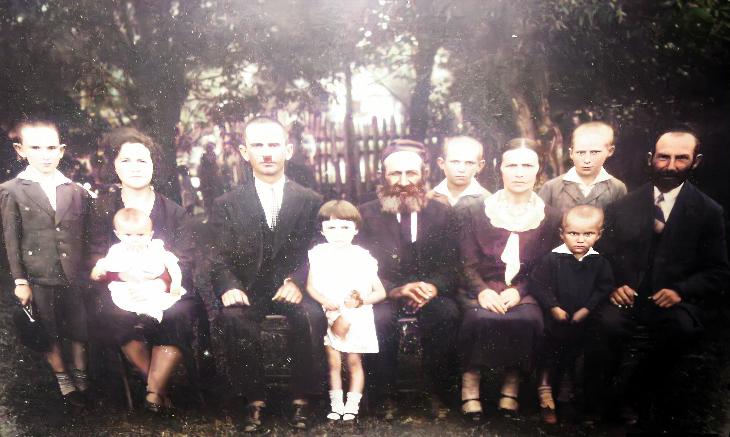 My father’s family in Poland. All murdered during the Holocaust, except my father who is in the back row, second from the right.








Yesh koah for the powerful article!
I'd add number 5. to remember:
Righteous among the nations, soldiers of the Allied armies, and others who saved the Jewish people and fought the nazism, risking their lives and livelihood. Unfortunately not so many of these people are still alive now either, and it's our duty to preserve their memory as well.
Thank you, and yes, good point
Preserve their lives right now. Yael Eckstein group try to hv volunteers and paid help spend time with them not just drop food off and run. God help there be others. Who do we give to,?
Outstanding
Inspirational
Thank you very much