



 Bestselling Author Freida McFadden Reveals Her True Identity







4 min read


Inside a Nazi death camp, starving prisoners composed a prayer that will transform your Passover Seder.
In the Bergen-Belsen concentration camp during Passover 1944, the Jewish prisoners faced an impossible situation. There was no matzah. There was only chametz—and to refuse it meant starvation, or worse.
The rabbis in the camp ruled that the Jews must eat to survive. Jewish law is unambiguous: pikuach nefesh, the preservation of life, overrides virtually every commandment.
But the prisoners didn’t just eat and move on. They did something extraordinary.
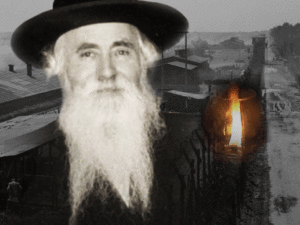
They recited a prayer that was composed by two Dutch rabbis: Rabbi Aaron Davids, Chief Rabbi of Rotterdam, and Rabbi Abraham Salomon Levisson, Chief Rabbi of Friesland and Gelderland. Tragically, both men died just weeks before Bergen-Belsen was liberated in the spring of 1945. They never lived to see the freedom they prayed for. But the prayer they wrote survived—and it has the power to transform your Passover.
Here’s the text of the prayer. Read it slowly:
Heavenly Father, it is manifest and known to You that we desire to carry out your will in regard to the commandment of eating matzah, and strictly refraining from chametz on the Festival of Pesach. But we are sick at heart at being prevented in this by reason of the oppression and mortal danger in which we find ourselves. We stand ready to perform Your commandments of which it is said, "You shall do them and live by them," (Vayikra 18:5) that is to say, you shall live by them and not die by them. And accordingly we heed Your warning, as it is written: "Take heed to thyself and keep thy soul alive." (Devarim 4:9)
Therefore we beseech You that You will keep us in life and establish us and redeem us speedily from our servitude so that we may in time come to perform Your statutes and carry out Your will with a perfect heart. Amen.
At our Seder table, just before we reach the section of the Haggadah that introduces the mitzvah of eating matzah, one of the children rises and reads this prayer aloud to everyone at the table. The room goes quiet. Every year, without fail.
It is a moment of focused gratitude, for the ability to sit as free people, surrounded by family and to have the privilege of fulfilling the very mitzvah that these holy rabbis and their fellow prisoners so desperately longed to perform. It makes the matzah taste different. It makes the whole Seder feel different.
Try it at your own table this year. You don’t need to add a speech. You don’t need to explain. Just let a child read the prayer. The words will do the rest.
Passover is the holiday of gratitude. For seven days you are called to remember that you were slaves and that you were set free. Matzah itself is called the bread of freedom—for seven days you eat this bread and are invited to appreciate, deeply and deliberately, the freedom in your life.
Real gratitude requires contrast, knowing what the alternative looks like. And that is what the Bergen-Belsen prayer gives you.
So as you sit down to your Seder this year, let the entire week of Passover be a week of recognition. Recognize the faces around your table. Cherish the special family moments. Feel connected to the deeper meaning that you are blessed to have in your life. And recognize that you are the living answer to a prayer composed in a death camp more than 80 years ago.
Bergen-Belsen was liberated on April 15, 1945, just days after Passover ended.
The prayer was answered.
Not in the way most of the prisoners had hoped—thousands had already perished, and thousands more died even after liberation. But the Jewish people survived. The prayer endured. And here you are, reading it, decades later, free.
This Passover, when you lift your matzah and say the blessing, you are completing something those prisoners began. You are the continuation of their story. You are the answer to their prayer.
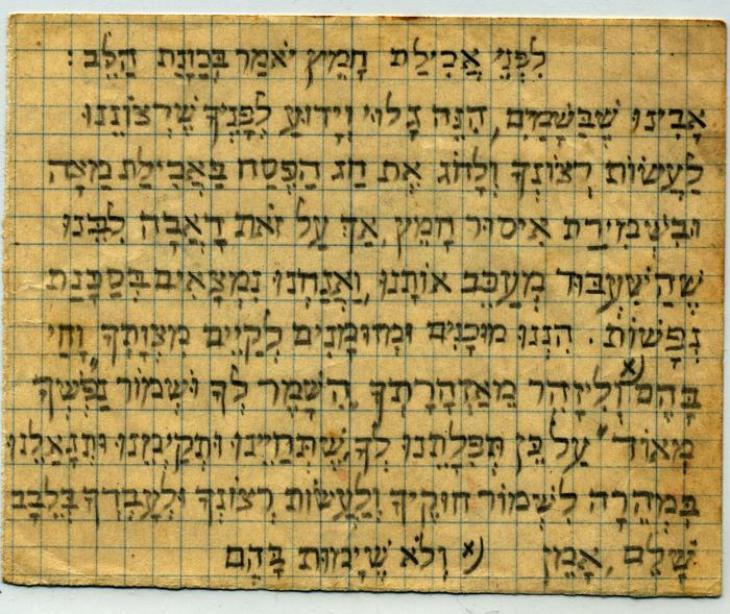
לפני אכילת חמץ יאמר בכונת הלב:
אבינו שבשמים הנה גלוי וידוע לפניך שרצוננו לעשות רצונך ולחג את חג הפסח באכילת מצה ובשמירת איסור חמץ. אך על זאת דאבה לבנו שהשעבוד מעכב אותנו ואנחנו נמצאים בסכנת נפשות. הננו מוכנים ומזומנים לקיים מצותך "וחי בהם" ולא שימות בהם, ולזהר מאזהרתך "השמר לך ושמור נפשך מאוד." על כן תפלתנו לך שתחיינו ותקיימנו ותגאלנו במהרה לשמור חוקיך ולעשות רצונך ולעבדך בלבב שלם, אמן.
Before eating Chametz [on Passover] say the following with intent & devotion:
Heavenly Father, it is manifest and known to You that we desire to carry out your will in regard to the commandment of eating matzah, and strictly refraining from chametz on the Festival of Pesach. But we are sick at heart at being prevented in this by reason of the oppression and mortal danger in which we find ourselves. We stand ready to perform Your commandments of which it is said, "You shall do them and live by them," (Vayikra 18:5) that is to say, you shall live by them and not die by them. And accordingly we heed Your warning, as it is written: "Take heed to thyself and keep thy soul alive." (Devarim 4:9)
Therefore we beseech You that You will keep us in life and establish us and redeem us speedily from our servitude so that we may in time come to perform Your statutes and carry out Your will with a perfect heart. Amen.











My mom(obm) told me that also in Auschwitz-Birneau the Jews made a Seder, the courage and faith to make Seders in concentration camps, was a form of resistance for our enemies , even though we were like slaves in Egypt we believed in freedom, that some day the Jews will be free, if they lived through the horrors of the Holocaust, and some survivors ended up in then Palestine to rebuild the land of Israel
My Grandfather, Abraham Popower, was murdered at Bergen Belsen Concentration Camp two weeks before the British liberated the camp. Thank you for sharing this important bit of history. We corporate this into our Sedar, Thank so very much for sharing this.
This prayer was distributed to the inmates of the camp by young boys who wrote it down on scraps of paper after returning to their barracks after 12 hours of harsh labor. One of these boys was Elchanan Emanuel (my husband's uncle, who did not survive). We, too, have the copy of the prayer written in his handwriting on our seder table each year, and we also read it out. The Emanuel family in the camp stinted on their mingy portions of potatoes for three weeks before Pesach, so that they themselves did not need to eat bread. For more on that Pesach (1944) and the next Pesach, see my father-in-law's book Dignity to Survive by Yonah Emanuel. An absolutely inspiring read.
Chag Sameach to everyone, and may we merit the true redemption very soon!